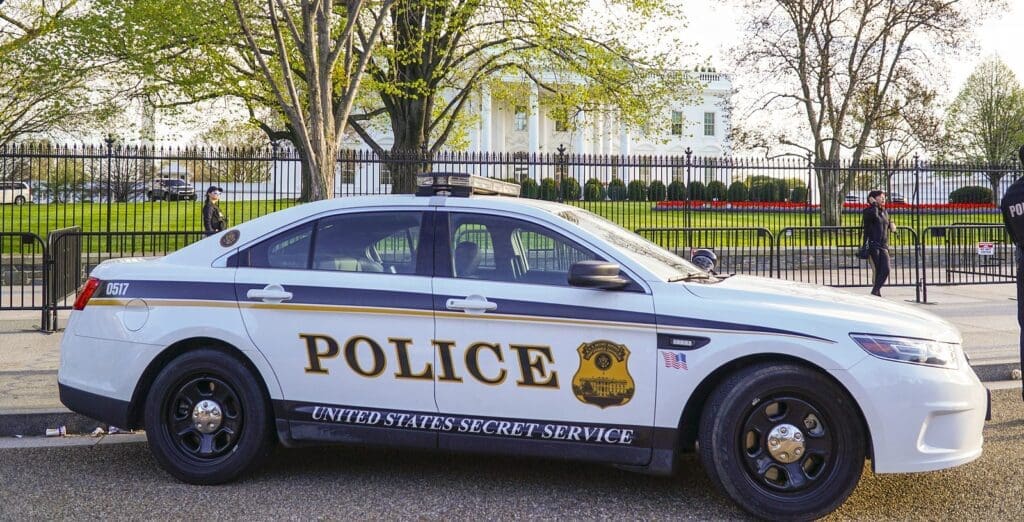

CBS 60 Minutes reports a sharp increase in threats against protected officials as federal investigators identify weaknesses in Secret Service policies and questions emerge about counter-drone procurement.
WASHINGTON, D.C. – October 25, 2026 (STL.News) The highly regarded United States Secret Service is confronting increased demands on its protective operations as agency leaders report rising threats against national officials, a federal watchdog identifies weaknesses in security policy management, and separate news investigations raise questions about the agency’s counter-drone program.
During an October 11, 2026, 60 Minutes broadcast, Secret Service Director Sean Curran told CBS News that threats against individuals receiving full-time protection had increased by just over 40% compared with the previous year.
Curran also reported approximately 10,000 threat cases involving Secret Service protectees since January 2026.
The two figures measure different things. The percentage increase concerns full-time protectees, while the approximately 10,000 cases involve the broader population receiving Secret Service protection.
Those figures are agency-reported statistics, not independently audited findings. They also do not represent 10,000 assassination attempts.
Separately, a September 3, 2026, Government Accountability Office report documented 83 security incidents during fiscal years 2015 through 2025. The agency updated protective policies following 25 of those incidents.
The GAO did not conclude that all 83 incidents represented operational failures or that every incident required a policy change.
Additional reporting by RealClearPolitics and NewsNation examined Deputy Director Matthew Quinn’s announced departure and questions surrounding the agency’s counter-drone program.
Together, these developments provide insight into the operational demands, management challenges and accountability issues facing the federal organization entrusted with protecting America’s national leadership.
CBS Reporting: Threats Against Protected Officials Increase
CBS correspondent Norah O’Donnell interviewed Curran and Quinn for the October 11 60 Minutes report.
Curran described a changing security environment shaped by digital communications, rapidly circulating information, and rising threats against public officials.
He attributed part of the changing environment to the internet, which has made information about protected individuals more accessible.
Threat investigations can involve communications, suspicious conduct, and other circumstances requiring law enforcement evaluation.
Not every reported threat represents an imminent physical danger.
Nevertheless, investigators must assess potentially dangerous individuals while distinguishing credible threats from statements that do not indicate an immediate risk.
The agency conducts these investigations while protecting presidents, vice presidents, former presidents, visiting foreign leaders, and other designated individuals.
The reported increase in threats adds to the demands on an organization whose protective responsibilities require extensive planning, intelligence gathering, and coordination.
CBS Reporting: The Butler Assassination Attempt
The July 13, 2024, assassination attempt against Donald Trump during a campaign rally in Butler, Pennsylvania, remains a central event in the Secret Service’s recent history.
Trump, then a former president and presidential candidate, was wounded when a gunman opened fire from a nearby rooftop.
Rally attendee Corey Comperatore was killed, while David Dutch and James Copenhaver were seriously injured.
Curran served as the lead Secret Service agent responsible for Trump’s protection during the event.
During his CBS interview, Curran acknowledged requesting additional security resources before the shooting but declined to discuss the details.
The attack triggered congressional investigations, federal reviews, and leadership changes.
Former Secret Service Director Kimberly Cheatle resigned after criticism of the agency’s security handling at the rally.
The CBS investigation also discussed findings from a Department of Homeland Security inspector general review identifying missed opportunities to detect and disrupt the attack.
The Butler shooting remains an important reference point in examinations of advance planning, communication and coordination among law enforcement agencies.
CBS Reporting: Training and Recruitment Expand
Deputy Director Quinn told 60 Minutes that approximately 942 people were in training at the time of the October 2026 interview.
He compared that figure to about 200 the previous year.
The figures indicate a substantial expansion of the agency’s training pipeline.
However, trainees are not necessarily fully qualified personnel available for immediate operational assignments.
Secret Service special agents receive instruction in criminal investigations, protective operations, firearms, emergency response and other specialized responsibilities.
Protective assignments can involve extensive travel, irregular schedules, and rapidly changing security conditions.
The agency must also maintain experienced personnel to supervise complex operations and train new employees.
The training figures Quinn reports describe recruitment and training activity. They do not, on their own, establish that all staffing requirements have been met.
CBS Reporting: Presidential Motorcade Improvements
The October 11 broadcast also examined changes to presidential transportation and emergency medical preparedness.
According to CBS, Curran added a medical response truck to presidential motorcade operations following the Butler assassination attempt.
The network described the vehicle as containing a trauma unit and a field surgeon capable of treating serious injuries.
CBS also reported adding an armored personnel carrier and examined the protective features of the presidential limousine, commonly known as the Beast.
For security reasons, many of the limousine’s capabilities remain undisclosed.
The reported additions reflect the importance of emergency medical preparedness during presidential travel.
CBS reporting and statements from Secret Service officials are the sources of these descriptions. STL.News did not independently inspect the equipment or verify its technical specifications.
CBS Reporting: Counter-Drone Technology
One of the most significant subjects in the CBS investigation involved unmanned aircraft.
Commercial drones have become increasingly accessible and capable of conducting aerial surveillance, creating security concerns near protected locations and major public events.
Quinn described a multimillion-dollar program developing defensive and offensive drone capabilities.
CBS demonstrated the DroneHunter system, which uses radar and artificial intelligence to identify and intercept aircraft.
During the demonstration, the system captured a target drone using a net and transported it to a designated location.
The network also reported that Secret Service officials were studying developments in drone warfare in Ukraine.
Quinn acknowledged that protecting against coordinated drone swarms remained an unresolved challenge.
The televised demonstration showed the system functioning under the conditions presented. It did not establish its effectiveness under every operational scenario.
Questions about the program received additional attention after reporting on Quinn’s departure.
Separately Reported: Matthew Quinn’s Departure
On October 16, 2026, RealClearPolitics reported that Quinn had announced his resignation in an internal agency email, with November 7 scheduled as his final day.
The publication raised questions about Quinn’s previous employment with Fortem Technologies, a manufacturer of the DroneHunter interception system featured during the CBS broadcast.
Quinn retired from the Secret Service in 2021 after more than two decades of federal law enforcement service.
He later served as senior vice president at Fortem Technologies before returning to the Secret Service as deputy director in May 2025.
His official Secret Service biography disclosed his previous employment with Fortem.
RealClearPolitics reported concerns from current and former agents about equipment performance, procurement practices, and potential conflicts of interest.
Those concerns remain allegations raised in published reporting.
The reporting did not establish that Quinn violated federal ethics requirements or that a procurement decision was unlawful.
RealClearPolitics also reported that the Secret Service had not responded to its questions about the program before publication.
Separately Reported: Quinn Explains His Departure
NewsNation published additional information from Quinn’s departure letter.
According to the publication, Quinn said he intended to spend more time with his family and described his departure as a transition previously discussed with Director Curran.
Quinn had returned to the agency from retirement at Curran’s request.
In his message, he expressed confidence in the agency’s direction and cited improvements in leadership and law enforcement staffing.
NewsNation also reported that Quinn denied having a conflict of interest involving his previous employment with Fortem Technologies.
That denial is relevant to evaluating the allegations concerning the counter-drone program.
The available reporting does not establish that procurement questions caused Quinn’s resignation.
Therefore, evaluate his departure, stated reasons for leaving, and the allegations involving procurement separately.
Previous employment with a government contractor does not, by itself, establish an ethics violation.
Any determination of misconduct would require additional evidence or findings from an authorized investigation.
Federal Findings: GAO Documents 83 Security Incidents
The Government Accountability Office’s September 3 report, GAO-26-108455, examined Secret Service protective policies and incident reviews covering fiscal years 2015 through 2025.
Investigators documented 83 security incidents during that period.
The agency updated protective policies following 25 incidents.
The GAO did not classify all 83 incidents as operational failures or conclude that every incident required a policy revision.
Instead, investigators found that the agency did not require personnel to document their reasoning when deciding that an incident did not warrant a policy change.
That omission made it difficult to determine why the agency maintained existing procedures.
The watchdog recommended requiring written explanations for such decisions to strengthen accountability and improve future reviews.
The report also examined whether existing policy management procedures adequately incorporated lessons from previous security incidents.
Federal Findings: Earlier Drone Incidents
The GAO examined the agency’s response to drone-related incidents in 2015, 2016, and 2021.
In December 2015, a drone inadvertently came into contact with President Barack Obama’s motorcade in Hawaii.
In May 2016, an individual flew a drone approximately 200 feet above a crowd attending a Bernie Sanders campaign rally in San Jose, California.
During the January 2021 presidential inauguration, Secret Service personnel observed multiple drones shortly before President Joe Biden arrived.
The aircraft were subsequently identified as authorized drones operated by U.S. Customs and Border Protection.
The 2021 incident prompted an immediate policy change clarifying which Secret Service personnel had primary responsibility for drone countermeasures.
However, that change did not establish a policy addressing civilian drone use.
The GAO found that none of the three incidents produced policy updates addressing situations in which civilians use drones and cause security incidents.
In July 2024, the attacker involved in the Butler assassination attempt used a drone before the shooting.
According to the GAO, the attacker flew the drone for approximately 11 minutes over the rally crowd, helping him position himself before opening fire.
The watchdog did not conclude that earlier policy revisions would necessarily have prevented the attack.
Instead, investigators emphasized the importance of documenting decisions about whether incidents require changes to protective procedures.
The finding shows how emerging technology can create risks that require ongoing evaluation.
Federal Findings: Eight Policies Overdue for Review
The GAO also examined compliance with the agency’s policy review requirements.
Secret Service procedures required the agency to review and update protective policies within four years of issuance.
Investigators found that eight of 22 policies related to domestic and foreign protective advance planning had not been reviewed or updated within the required period.
The 22 policies represented the group examined in this portion of the GAO’s review, not necessarily every protective policy maintained by the Secret Service.
Agency officials cited limited staff availability as a challenge to completing reviews.
The GAO recommended assigning responsibility for policy updates to specific positions within relevant offices.
An overdue review does not necessarily mean that a policy is ineffective.
However, regular evaluations help ensure that operational guidance reflects changing threats and lessons from previous incidents.
Federal Findings: International Agreement Dates to 1991
Another GAO finding involved coordination between the Secret Service and the State Department’s Diplomatic Security Service.
The organizations share certain responsibilities involving American officials traveling internationally and foreign dignitaries visiting the United States.
A 1991 memorandum of understanding defined aspects of those responsibilities.
According to the GAO, the agreement had not been updated since its establishment.
The agreement still described the Secret Service as part of the Treasury Department, although the agency transferred to the Department of Homeland Security in 2003.
Investigators recommended revising the memorandum to reflect current responsibilities and security requirements.
The Department of Homeland Security and Department of State concurred with the recommendations.
The GAO issued four recommendations addressing incident documentation, policy review responsibilities, and interagency coordination.
Background: The Secret Service’s Financial Crime Mission
Although presidential protection receives the greatest public attention, the Secret Service maintains a substantial financial investigative mission.
Established in 1865 to combat counterfeit currency, the agency expanded its responsibilities as financial crimes became more sophisticated.
Today, it investigates counterfeiting, payment fraud, cyber-enabled financial crimes and other offenses affecting the nation’s financial infrastructure.
Its Cyber Fraud Task Forces bring together investigators, prosecutors, law enforcement agencies and private-sector specialists to address complex financial crimes.
The agency also investigates the illicit use of digital assets when associated with offenses within its jurisdiction.
Modern financial investigations frequently involve electronic payment systems, stolen financial information and criminal networks operating across international borders.
These responsibilities require expertise in digital evidence, financial transactions and cybersecurity.
The Secret Service therefore maintains capabilities to support two demanding missions: protecting national leaders and investigating crimes that affect financial institutions, businesses, and consumers.
STL.News Analysis: What the Findings Mean
The CBS reporting and GAO investigation address different aspects of Secret Service operations.
CBS examined the agency’s current threat environment, staffing, and protective capabilities through interviews and demonstrations.
The GAO evaluated whether internal procedures consistently incorporated lessons from security incidents and maintained current protective policies.
Taken together, the reports raise three important questions.
Can Staffing Keep Pace With Threats?
Quinn’s reported increase in trainees suggests an expanded recruitment effort.
However, trainee numbers alone do not show whether the agency has enough experienced personnel to meet its protective and investigative responsibilities.
Evaluating staffing readiness requires additional information on personnel assignments, attrition, qualifications, and operational requirements.
Are Protective Policies Adapting Quickly Enough?
The GAO’s findings on drone incidents underscore the need to review procedures as technology changes.
The agency’s development of counter-drone capabilities demonstrates an operational response to emerging risks.
However, equipment improvements and policy management are separate issues.
Effective security requires both capable technology and procedures that reflect current conditions.
The GAO’s documentation findings also demonstrate why decisions against making policy changes should be recorded.
Without those explanations, future reviewers may struggle to determine whether an emerging threat was adequately considered.
How Should Procurement Questions Be Evaluated?
Reporting on Quinn’s previous employment and the counter-drone program raises questions that warrant independent review.
However, previous employment with a contractor does not, by itself, establish a conflict-of-interest violation.
Quinn has denied having a conflict of interest, according to NewsNation.
Determining whether procurement decisions complied with applicable requirements would require examination of relevant records, disclosures, recusals, and official findings.
Without that evidence, allegations should not be presented as established misconduct.
STL.News Analysis: Accountability Beyond Individual Incidents
The Butler assassination attempt demonstrated the consequences of serious security vulnerabilities.
The GAO report subsequently identified weaknesses in policy documentation and review procedures.
Those findings do not establish that inadequate policies caused every security incident.
They do, however, support the importance of consistent review procedures for an agency responsible for protecting national leaders.
The central management issue is whether the Secret Service can identify lessons from incidents, document decisions, and implement necessary changes.
Public accountability should therefore focus on measurable corrective actions rather than assumptions about individual motives or institutional performance.
Congressional oversight, independent federal reviews, and responsible journalism can support that process by identifying deficiencies and examining whether corrective actions have been implemented.
Conclusion: Presidential Protection Requires Adaptation
More than 160 years after its establishment, the Secret Service still protects national leaders and investigates financial crimes affecting the American economy.
CBS News has reported an increase in threats against protected officials and examined the agency’s efforts to strengthen staffing, emergency response, and drone defenses.
The GAO has independently documented weaknesses in protective policy management and recommended corrective action.
Separate reporting concerning Matthew Quinn has raised questions about the counter-drone program, but the available evidence does not establish misconduct.
These developments underscore the need to distinguish operational improvements from management accountability.
New equipment and additional training may strengthen protective capabilities, but they do not eliminate the need for consistent policies, effective coordination, and independent oversight.
For the public, the most meaningful measure of progress will be whether the agency corrects documented deficiencies and whether protective procedures continue to adapt to emerging threats.
The Secret Service must balance operational secrecy with accountability while maintaining its responsibilities across presidential protection and financial crime investigations.
The documented facts show an agency facing evolving security risks and identifiable management challenges. Whether its corrective measures are sufficient will depend on future operational performance, independent oversight, and verifiable implementation of recommended improvements.
Sources and Editorial Disclosure
CBS News — 60 Minutes, October 11, 2026
Secret Service Confronts Rise in Threats to Protectees, reported by Norah O’Donnell.
U.S. Government Accountability Office — September 3, 2026
Secret Service: Protection Policies Should be Consistently Updated to Better Ensure Protectee Safety, GAO-26-108455.
https://www.gao.gov/products/gao-26-108455
RealClearPolitics — October 16, 2026
Secret Service Deputy Director Resigns Amid Drone Controversy, by Susan Crabtree.
NewsNation — October 16, 2026
Exclusive: Matt Quinn Says Secret Service Is ‘Well-Positioned’ in Exit Email, by Libbey Dean.
https://www.aol.com/articles/newsnation-obtains-secret-deputy-director-191957000.html
U.S. Secret Service
Official agency history, protective responsibilities and financial investigative mission.
https://www.secretservice.gov/
Editorial Disclosure
This article combines attributed reporting, official federal findings and clearly identified STL.News analysis.
Threat statistics, staffing figures and descriptions of protective technology are attributed to Secret Service officials interviewed by CBS News.
Findings involving security incidents, overdue policy reviews and interagency agreements are attributed to the Government Accountability Office.
Questions about Matthew Quinn’s previous employment and the counter-drone program come from published reporting. The article also includes Quinn’s denial of a conflict of interest. The sources reviewed establish no ethics violation, unlawful procurement decision, or other misconduct by Quinn.
STL.News did not conduct the CBS interviews or federal investigations. This article synthesizes publicly reported information and federal records and draws analytical conclusions, using AI, which is identified separately from factual reporting.

